


A privacy hedge should make your garden feel sheltered. When gaps appear, you start seeing the boundary wall, neighbouring property or street through plants that once provided cover.
The usual response is to ask the gardener to trim it neatly or add fertilizer. Neither should be automatic.
A thinning hedge needs its growing conditions and pruning history checked first. The right solution depends on whether the problem affects the whole hedge, its lower branches or individual plants.
Here is what Dubai villa owners should look for before arranging another cut or replacing established planting.
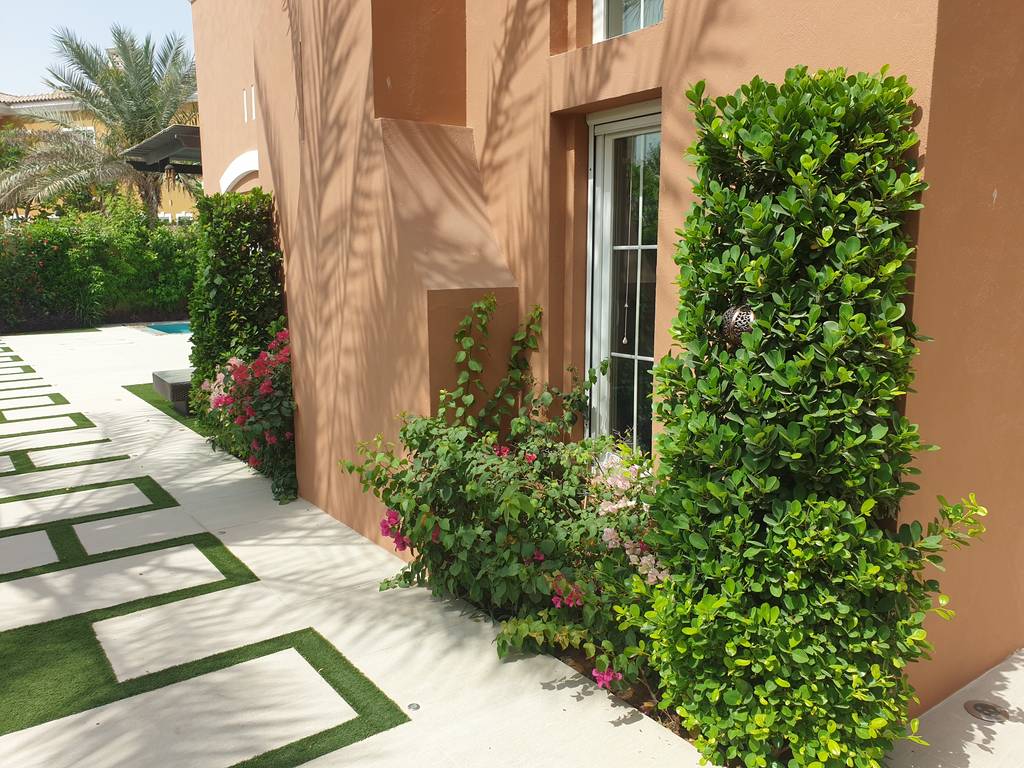
1. The hedge is thick at the top but bare underneath
Stand back and look at the hedge’s outline. Does its upper growth extend further out than its base?
A broad top can shade the lower branches. Over time, the bottom may become thin even while the upper growth remains dense.
For many formal hedges, a slightly tapered shape—with the base wider than the top—helps light reach the lower foliage. Both the RHS and University of Minnesota Extension recommend this approach.
What helps: Ask your gardener to review the shape before trimming. Correcting the outline may need several visits, especially where a major cut would remove too much screening at once.
A better shape supports future growth, but it cannot guarantee that every bare branch will produce new leaves.
2. The hedge has outgrown its space
A hedge planted beside a narrow walkway can eventually become difficult to manage. Each trim pushes it back towards the boundary, leaving little room for a healthy layer of foliage.
Before blaming the maintenance schedule, consider whether the plant suits the space available. Choosing a suitable species and allowing for its eventual size are important parts of successful hedge planting.
What helps: Assess the hedge’s intended height and width. Can it stay within those limits without repeatedly cutting into old, bare growth?
If the answer is no, the longer-term solution may involve changing the planting layout or selectively replacing unsuitable plants. Repeatedly forcing the same hedge into too little space may not produce the result you want.
3. One plant is struggling while the rest look healthy
An isolated gap needs a closer inspection.
Check whether the affected plant receives water, whether the surrounding soil differs from the rest of the bed, and whether there is visible damage to its stems or leaves. These observations help your gardener decide what to investigate next.
Photograph the whole plant as well as the affected foliage. A close-up alone may miss an important clue, such as a disconnected irrigation line or damage near the base.
What helps: Request an assessment of the individual plant before replacing it. Ask what may have caused its decline and whether that condition would also affect a replacement.
If watering appears uneven, read our guide to irrigation problems in Dubai villa gardens.
4. A heavy cut has exposed bare branches
A hedge can look dramatically thinner immediately after a severe trim. Whether it fills out again depends partly on the plant.
Some hedging species tolerate renovation pruning; others respond poorly when cut into old wood. The RHS specifically cautions that many overgrown conifer hedges are unsuitable for this approach. Pruning advice therefore needs to match the species rather than follow one rule for every hedge.
What helps: Identify the plant before authorising a major reduction. Ask the gardener to explain:
- How much living foliage will remain.
- Whether the species can regrow from the proposed cuts.
- Whether the work should be spread over stages.
- How privacy will be affected during recovery.
For a Dubai garden, pruning timing should also reflect local conditions and the plant’s growth cycle. A calendar written for a different climate should not be copied directly.
Should you prune, repair gaps or replace the hedge?
These options solve different problems. An inspection should help you choose between them.
| What you notice | What to discuss with your gardener |
|---|---|
| Dense top with a thin base | Whether the shape is shading lower growth |
| One unhealthy plant | Local watering, root-zone conditions and visible damage |
| Bare branches after a severe cut | The species’ ability to recover from old wood |
| Hedge repeatedly blocking a path | Whether the plant suits the available space |
| Several dead or missing plants | The cause of losses and a suitable replacement plan |
The aim is to retain useful, healthy planting where possible. Replacement becomes more worthwhile when plants have died, cannot recover adequately or are fundamentally unsuitable for their position.
Will fertilizer make a bare hedge thick again?
Fertilizer should not be the first answer to every gap.
Ask what evidence suggests a nutrient problem. If lower branches are shaded or the hedge has been cut beyond its ability to regrow, feeding alone will not correct the underlying issue.
A useful maintenance plan should explain the reason for each treatment and what improvement the team expects to monitor. Avoid approving repeated applications simply because the hedge has not yet become green.
What proper hedge maintenance should look like
Good hedge maintenance in Dubai starts with an agreed result: the height you need, the space available and the privacy you want to retain.
Discuss those priorities before work begins. A photograph marked with the preferred outline can prevent misunderstandings about how much should be removed.
During ongoing garden maintenance, ask the team to:
- Check for developing gaps before trimming.
- Review the hedge’s shape and access to light.
- Report individual plants that are declining.
- Check visible irrigation issues along the planting bed.
- Remove cuttings from paths, lawns and nearby pool areas.
- Record changes with photographs where recovery is being monitored.
The work should respond to the condition of the hedge. Every visit does not necessarily require another cut.
Arranging hedge trimming in Dubai with KAME Gardens
When enquiring, send a photograph of the full hedge and a closer view of the bare areas. Include its approximate height, your villa location and when it was last heavily trimmed.
KAME Gardens provides garden maintenance, pruning and hedge shaping in Dubai, alongside irrigation checks and other garden-care services. Discuss whether your hedge needs routine trimming, a staged recovery plan or separately quoted replacement work.
Contact KAME Gardens about hedge trimming and garden maintenance to explain the problem and discuss an appropriate scope of work.
Frequently asked questions
Why is my hedge green at the top but bare at the bottom?
One possible cause is shading from wider upper growth. Inspect the hedge’s shape and surrounding shade before deciding on corrective pruning.
Can a bare hedge grow back?
Some can, depending on the species, living growth and cause of thinning. A recovery promise should follow an inspection, particularly after severe pruning.
How often should hedges be trimmed in Dubai?
Frequency depends on the plant, its growth and the desired shape. Agree on a schedule based on those factors rather than cutting automatically at every maintenance visit.
Should I replace just one plant or the whole hedge?
Contact KAME Gardens
Garden Maintenance | Pool Maintenance | Landscaping | Plant Supply
📞 Call / WhatsApp: +971 56 702 6368
🌐 Website: www.kamegardens.ae
📍 Location: Dubai, UAE
